Sleep & interiors
How to Choose a Luxury Mattress in the UK: Firmness, Fillings and Split Tensions
A luxury mattress is not simply a softer mattress, nor is a high spring count a shortcut to better sleep. The right choice comes from understanding how firmness, fillings and construction work together—and how those details suit the people who will sleep on it.
Published 14 October 2026
Buying a mattress is an intimate decision disguised as a furniture purchase. It must support a body for hours at a time, night after night, while fitting a room, a bed base and often two sleepers whose preferences are not the same. The word “luxury” adds another layer: it suggests fine materials and careful making, but does not tell you whether a particular mattress will feel right.
For UK shoppers comparing luxury mattresses, three questions deserve more attention than the label on the showroom card. What tension suits your sleeping position and build? Which natural mattress fillings affect the feel and temperature of the surface? And, if you share a bed, can each sleeper choose a different firmness without turning the mattress into a compromise?
There is no single correct answer. Firmness descriptions vary between manufacturers, and a mattress that feels supportive to one person may feel unyielding—or too yielding—to another. A useful way to approach the decision is to treat specifications as evidence, then test the result against your own comfort. Vispring provides a practical example: its Devonshire and Herald Superb models offer a choice of tensions, and king-size options can be specified with split firmness. Their construction also shows why a mattress should be judged as a complete system, not by one headline feature.
Begin with the sleeper, not the specification
Start with the way you sleep most often. Side sleepers typically need enough give at the shoulder and hip to reduce concentrated pressure while keeping the spine reasonably level. Back sleepers may prefer a more even surface that supports the lower back without allowing the pelvis to sink excessively. Stomach sleepers often find that a firmer, more level feel helps limit arching through the lower back. These are useful patterns, not rules: body shape, mobility, personal comfort and the mattress beneath all influence the experience.
Body weight also affects how deeply someone compresses a mattress. A lighter sleeper may experience the same model as firmer than a heavier sleeper does, because less force is applied to the spring and upholstery layers. Two people of similar weight can still disagree, however, because shoulder width, hip shape, preferred sleeping position and sensitivity to pressure are individual.
Think about the support you want rather than searching for a label that sounds reassuring. Do you feel pressure around your shoulders or hips? Does your lower back feel unsupported? Do you wake because the surface seems too warm or because movement from a partner travels across the bed? These observations give a retailer or sleep adviser something concrete to work with.
When testing in person, allow time to settle into each mattress. Lie in your usual sleep position, rather than sitting on the edge or pressing a hand into the surface. If you share a bed, try it together. Pay attention to whether you can relax without bracing against the mattress, and whether both sleepers can maintain a comfortable position. A brief test cannot perfectly reproduce a full night, but a deliberate one is more informative than choosing by appearance or price alone.
What firmness labels can—and cannot—tell you
Soft, medium, firm and extra-firm are useful shorthand. They are not universal measurements. One maker’s medium may feel different from another’s because spring design, upholstery depth, quilting, tension and the mattress base all contribute to the sensation at the surface. Even within a single range, construction can change how the same nominal tension feels.
Firmness and support are related, but they are not identical. Firmness describes the initial feel when you lie down; support describes how well the mattress holds your body in a comfortable, balanced position. A mattress can feel plush at first while still providing underlying support. Equally, a hard-feeling surface is not automatically better for posture. The goal is a comfortable position with no persistent pressure or sense of sagging.
For that reason, treat the maker’s tension options as a starting point for comparison. Ask what each option is designed to feel like, whether the recommendation changes with body weight or sleep position, and what trial or exchange arrangements apply. If you have a current mattress, describe what works and what does not. “I like firm” is less useful than “I sleep on my back, and my current mattress feels comfortable at the shoulders but lets my hips drop.”
A quality mattress can still be the wrong choice for a particular sleeper. The purpose of detailed options is not to make the decision sound technical; it is to make the fit more personal. A considered test, clear questions and a realistic understanding of your own comfort are more valuable than selecting the firmest or most elaborate specification by default.
Natural fillings: the layers behind the feel
The springs do important work, but they are only part of a mattress. Above them, upholstery materials shape the feel, cushioning and temperature experience. Luxury designs may use natural fibres such as wool and cotton, sometimes in carefully arranged layers. Their behaviour differs from that of the spring unit: fillings soften the contact surface, add resilience and help manage moisture and warmth.
Wool is valued in bedding for its ability to absorb and release moisture vapour. This can help create a more comfortable sleeping environment, though it should not be mistaken for a promise that anyone will sleep cool in every room or season. Room temperature, bedding layers, sleepwear and individual physiology all matter. Wool’s resilience can also contribute to a surface that feels substantial without relying solely on foam-like cushioning.
Cotton can provide a breathable, even layer within an upholstery stack. The combination and arrangement of fibres affect how the surface settles under pressure and how the mattress feels over time. A description of “natural fillings” is a beginning, not a complete account: ask which materials are used, where they sit in the construction, and how the layers are held in place.
Hand-tufting is one construction detail worth understanding. In a tufted mattress, fastenings pass through the layers to help secure the upholstery and limit movement within the filling stack. The surface may have visible dimples or a more traditional, tailored appearance. Tufting is not a guarantee of comfort by itself, but it can tell you something about how the mattress is assembled and finished.
Care requirements deserve a place in the conversation, too. Follow the manufacturer’s instructions for rotating, turning or maintaining the mattress, and confirm whether the model is designed to be turned. A well-made mattress is a long-term household purchase, but longevity depends on suitable support from the bed base, sensible use and appropriate care. Construction quality and material choice should be considered alongside those practical conditions.
A practical example: Vispring tension choices
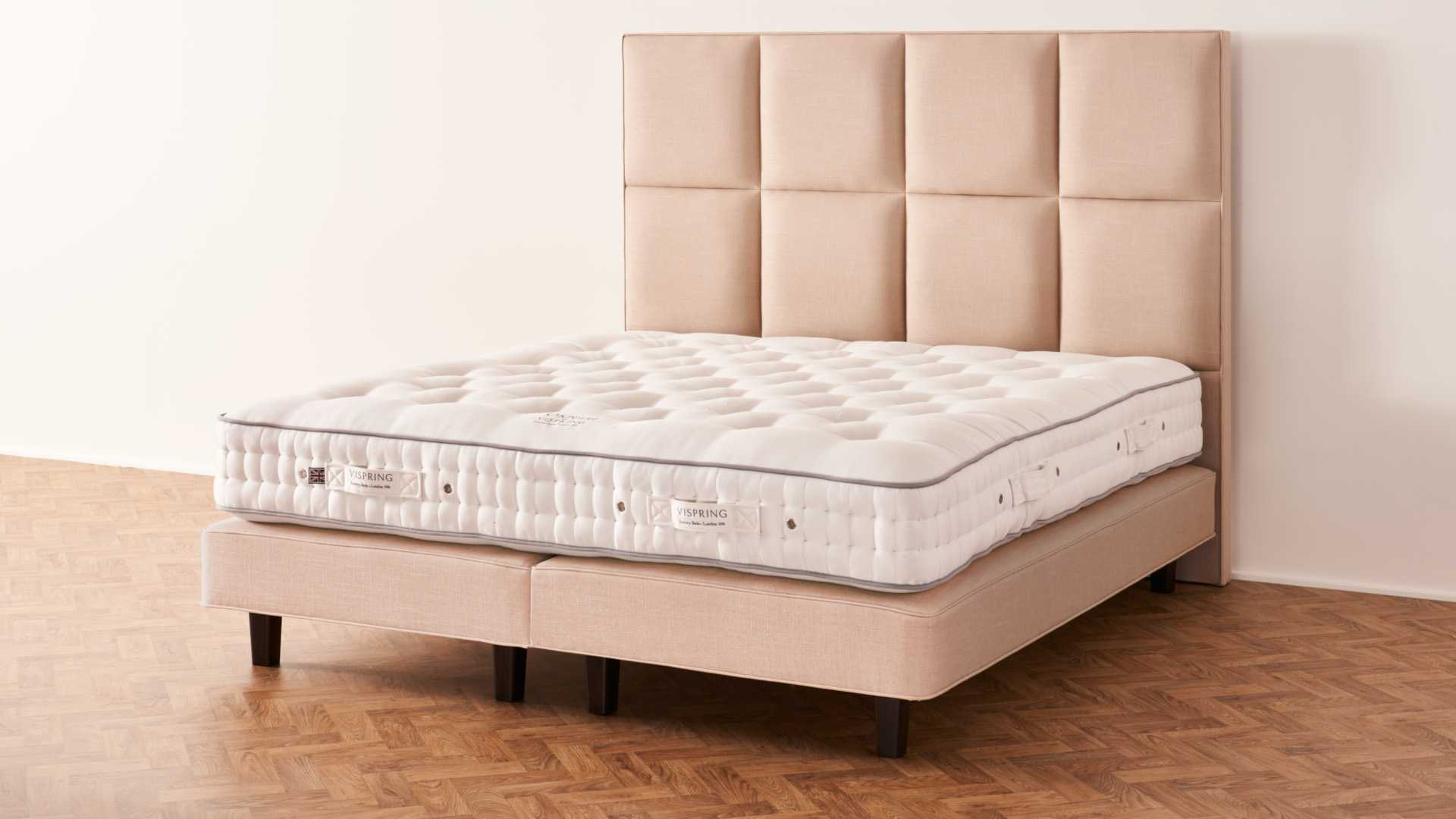
The Vispring Devonshire Mattress illustrates how a maker’s construction and tension options can be considered together. Its listed specification includes a hand-nested calico pocket-spring system, natural wool upholstery and a choice of Soft, Medium, Firm or Extra Firm tension. The king-size version can be ordered with split firmness for partners who want different feels on their respective sides.
Those details provide useful questions to ask rather than a verdict about who should buy it. A shopper might ask how the Devonshire’s wool layers affect the surface feel, what each tension is likely to feel like in the showroom, and how the recommended bed base influences the finished setup. The model’s spring construction and upholstery are part of the same experience; one cannot be evaluated fully without the other.
The Vispring Herald Superb offers another example of why it is worth reading beyond a product name. Its available details describe hand-nested calico pocket springs, British wool and cotton upholstery, hand-tufting, and Soft, Medium, Firm and Extra Firm choices. King sizes can also be specified with split firmness. This makes the model relevant to shoppers comparing how tension choice sits within a broader combination of springs, fillings and finishing.
Neither model should be selected solely because it offers a particular material or number of springs. The specifications explain how the mattresses are built; the best match still depends on how each sleeper responds to the whole surface. If possible, try the precise tension being considered and verify current details with the retailer, including dimensions, base compatibility, delivery and any options available for a particular size.
Split firmness: a solution for two different sleepers
Sharing a bed does not require sharing the same preference. One partner may want a softer feel while the other prefers a firmer surface. A split-firmness mattress allows the two sides of a larger bed to be specified at different tensions, creating a more tailored arrangement without requiring two entirely separate beds.
For couples, the benefit is straightforward: each person can choose a side that better reflects their comfort needs. It can be particularly useful when partners have different body weights, sleeping positions or responses to pressure. It also changes the conversation. Instead of asking which compromise both people can tolerate, each sleeper can explain what they need from their own side.
Before ordering, confirm how the split is constructed and how it will feel at the centre of the bed. Ask whether the division is noticeable, whether the chosen size supports the option, and what happens if one person’s preference changes. Also consider the bed frame and base: a mattress arrangement may have requirements that affect fit and support. Practical details such as access to the bedroom and the route for delivery are worth checking when buying a substantial mattress in the UK.
Split firmness is not the same as a guarantee that movement will never be felt. Individual pocket springs are designed to respond locally, but how much movement reaches a partner depends on the whole construction, the sleeper’s movement and the bed setup. If partner disturbance is a concern, test the mattress together and ask how its spring unit is intended to behave. Manage expectations: no specification can replace an in-person assessment of comfort.
There is also a simple decision-making advantage. Each partner can assess their own side without being pressured into choosing a tension that suits only the other person. Agreement may still be needed on mattress height, overall feel, budget and appearance, but tension no longer has to be the point where one sleeper gives way.
Spring systems, depth and finishing details
Luxury mattress descriptions often include spring type, spring count, steel, pocket construction and tension. These terms matter, but none should be treated as a complete measure of quality in isolation. Spring count may vary by size, and a higher number does not automatically mean better support. The way the springs are arranged, the materials above them and the mattress’s overall design all contribute to the result.
Pocket springs sit in individual fabric pockets, allowing them to compress with some independence from neighbouring springs. In a hand-nested system, the pockets are arranged by hand as part of the construction. The intended effect is a responsive support layer that adapts across the sleeping surface. What that feels like depends on the spring tension, upholstery and sleeper—not just the words on the specification sheet.
Mattress depth can influence the finished bed height and the proportions of the room, as well as how a sleeper interacts with the surface. Check the full dimensions, including any domed top, and compare them with the bed frame, bedside tables and fitted sheets. A deep mattress can look generous and substantial, but it should remain practical to get into and out of, particularly for people with mobility concerns.
Look for information about the border, edge stitching, handles and ventilation. These details can support handling, finishing and airflow, but they should be read as part of the construction rather than as isolated selling points. Handles, for instance, are there to assist with moving or positioning—not necessarily to lift the full weight of a mattress without guidance. Follow the maker’s instructions to avoid damage.
A focused checklist for UK mattress shopping
Before making a final choice, bring the discussion back to the room and the people who will use the bed. A short checklist can keep a sophisticated purchase grounded in everyday needs:
- Position and comfort: Identify your most common sleep position and any pressure or support issues with your current mattress.
- Tension: Compare the maker’s firmness options in person where possible. Treat labels as relative descriptions, not a universal scale.
- Fillings: Ask which fibres are used, how the layers affect the feel, and what care the mattress requires.
- Shared preferences: If you and your partner disagree, ask whether a split-firmness option is available in the size you need.
- Base compatibility: Check the recommended bed base and confirm that the mattress dimensions and height suit your frame.
- Delivery and access: Measure stairs, landings and doorways, and confirm the delivery arrangements before ordering.
- Aftercare: Read the warranty and care terms, and ask whether the mattress needs rotating or turning.
- Trial terms: Understand any exchange or comfort policy, including conditions, time limits and potential costs.
Do not overlook the room’s temperature and bedding. A mattress contributes to the sleep environment, but it is one part of it. A warm duvet, heavy sleepwear or a poorly ventilated bedroom can affect comfort regardless of the mattress filling. Choosing a breathable natural-fibre mattress may be part of a considered approach, but it does not replace sensible layering and ventilation.
Price, value and the meaning of luxury
A luxury mattress can represent a significant investment, so value should be measured across more than the first impression. Consider the quality and traceability of the materials as presented by the maker, the care taken in construction, the comfort options available and the support offered after purchase. A large price tag alone establishes none of these.
Think, too, about how long you expect to use the mattress and whether it suits your current circumstances. A carefully made product may be designed for long service, but no mattress is immune to wear or unsuitable use. Matching it to an appropriate base and following care guidance are part of protecting the purchase.
Luxury, at its most useful, is not a contest in specifications. It is the fit between a thoughtful construction and a sleeper’s needs. Fine natural fibres, hand-finished details and a choice of tensions can all matter; they matter most when they add up to a surface you can rest on comfortably, without asking either partner to accept an avoidable compromise.
The decision, made more personal
Choosing a luxury mattress in the UK begins with a deceptively simple task: pay attention to how you sleep. From there, tension options, natural fillings and spring construction become tools for narrowing the field—not promises that one specification suits everyone. Firmness labels are helpful only when they are tested against your own experience.
For couples with different preferences, split firmness can turn a shared bed into a more individual arrangement. For anyone comparing natural mattress fillings, wool and cotton offer material qualities worth understanding, alongside questions about layering, care and the complete construction. Models such as the Vispring Devonshire and Herald Superb demonstrate how those decisions can be brought together in a single mattress, but the final test remains personal comfort.
Take time to compare, ask specific questions and check the practical details of the bed base, size and delivery. The right mattress is not necessarily the softest, firmest or most elaborate. It is the one that allows each sleeper to settle into a comfortable, supported position—and makes the end of the day feel like a welcome arrival.